Integrations

Wine ERP Integrations, Connected to Every System You Already Run On

Wine ERP Integrations and the Full Connection Set

Wine ERP integrations spanning accounting, market pricing, storefront sync, and every bonded-warehouse operator you actually run on — named plainly, because what a wine ERP connects to is one of the first things you need to know. Each one below is live in the platform today.

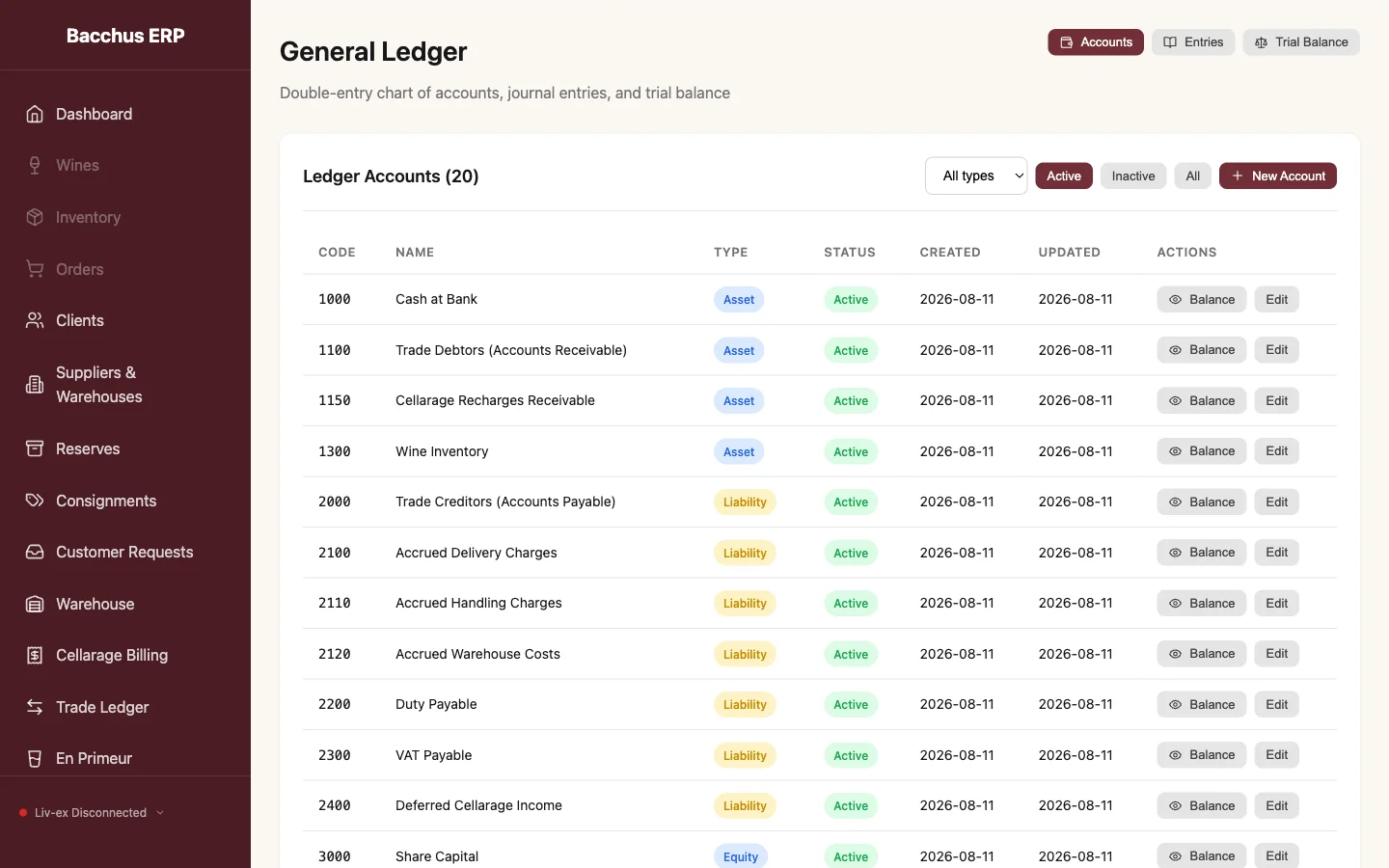
Bacchus ERP General Ledger screen showing the trade's own chart of accounts, including duty payable, VAT payable, and deferred cellarage income
The accounting side of every integration below: duty, VAT, and cellarage income as real ledger accounts, not a spreadsheet bolted on after the fact.

Flagship Integration

Live on Your Storefront, Not Bolted On Beside It

Shopify is where Bacchus ERP proves itself against a real, live storefront — not a sandbox. Orders, inventory, and customer identity move both ways, automatically, the moment something happens on either side.

Data & Accounting

Wine Trade Accounting Software: Numbers That Reach Your Books and Your Market View, on Their Own

As wine trade accounting software, Bacchus ERP keeps where your money is tracked and where the market is priced both live connections, not exports someone has to run.

Xero

A real OAuth2 connection to the Xero API — rotating refresh tokens, tenant assertion, rate-limit handling — is how Bacchus ERP posts full double-entry ledger entries onward to Xero, through the same adapter-agnostic GL seam behind every accounting platform Bacchus ERP connects to. Direction is one-way, Bacchus ERP → Xero. Every ledger posting queues for onward sync with retry and backoff, drained by a scheduled worker, so what happens on your books reaches Xero without anyone re-keying it.

Liv-ex

Market bid/offer pricing and wine reference data flow in continuously, with premium and floor pricing logic layered on top — so a quote reflects the market and the rules you've set over it. Direction is one-way, Liv-ex → Bacchus ERP: your own stock is never pushed back to the exchange, only priced against it.

LiveTrade / Bordeaux Index

Live trading-market data feeds directly into the Commercial Desktop's market view, through an adapter built for exactly this feed — your own stock beside the market, kept in step automatically as prices move. Direction is one-way, LiveTrade/Bordeaux Index → Bacchus ERP. Market data flows in beside your stock on the same screen, and from there a confirmation-gated order can be sent for execution inside Bacchus ERP's own Commercial Desktop rather than being routed through LiveTrade.

Bonded Warehouses

Every Bonded Warehouse, One Stock Record

Bond status, movement instructions, and reconciliation are modelled the same way across every bonded-warehouse operator and site — not a separate system per warehouse. See how Bacchus ERP's bonded warehouse stock management software handles multi-operator bond tracking in full.

London City Bond (LCB)

Movement instructions raise and confirm automatically the instant stock is released to London City Bond, with inbound landings and stock reports reconciled back against them and flagged the moment something doesn't match. Movement instructions flow Bacchus ERP → London City Bond on release. Landing confirmations and stock reports flow London City Bond → Bacchus ERP, back into the reconciliation queue.

Bordeaux City Bond (BCB)

The same operator/site model extends to Bordeaux City Bond — bond status, movement instructions, and reconciliation tracked exactly as they are for every other bonded site, on one stock record. Movement instructions flow Bacchus ERP → Bordeaux City Bond on release, and confirmations flow back the same way LCB's do.

Carvers Hill (CHE)

Carvers Hill sits in the same warehouse hierarchy as every other bonded operator — one stock record, one bond-status model, no separate system to keep in step with the rest. Movement instructions flow the same way — Bacchus ERP → Carvers Hill on release, reconciliation data flowing back — through the identical operator/site model rather than a bespoke integration.

Accounting Depth

Accounting That Arrives Itemised, Not Summed

A number that reaches your books as one line is a number nobody can audit afterwards. Bacchus ERP posts each part of a sale — the wine, the delivery, the duty, the VAT, and the cost of the sale itself — as its own balanced line against its own account, the same way it already posts a purchase.

One sale, six posted lines

General ledger posting for sales invoice INV-2026-0512. Trade debtors debited £1,360.80, against credits to sales revenue £1,200.00, delivery income £45.00, duty payable £37.20 and VAT payable £78.60. Cost of sale £807.00 debited against inventory £807.00, posted at the same time. Debit and credit totals both £2,167.80.
Account Debit Credit
Trade debtors £1,360.80
Sales revenue — wine £1,200.00
Delivery income £45.00
Duty payable £37.20
VAT payable — margin scheme £78.60
Cost of sale £807.00
Inventory £807.00
Totals £2,167.80 £2,167.80

Wine value, delivery, duty and VAT each post as their own line against their own account, tagged so Xero never re-computes a number the engine already worked out. The cost of sale posts in the same posting, at the moment the sale happens — not swept into a general expense line, and not left for a period-end adjustment to catch up on.
A Buyer’s Checklist for Any Vendor

Ask this of any wine-trade platform — including this one:

  • Does duty reach Xero as its own line? On Bacchus ERP, yes — duty posts to its own account, never folded into the wine value.
  • Is VAT posted under the margin scheme where it applies? On Bacchus ERP, yes — the same effective-dated engine that calculates margin-scheme VAT is what posts it.
  • Are delivery and cellarage separate accounts? On Bacchus ERP, yes — delivery, handling and cellarage each post to their own account rather than one line.
  • Is cost of sale posted at the moment of sale? On Bacchus ERP, yes — capitalised purchase costs are relieved into cost of sale in the same posting as the revenue they belong to.