Why It Matters
The Fine Wine Trade Isn’t a Retail Category — It’s a Trade of Its Own
The fine wine trade doesn’t treat a case of wine as a fixed unit. A lot bought en primeur becomes physical stock years later, moving between bonded and duty-paid status along the way; a case can split into individual bottles, or bottles can be repacked into a new case, and the record needs to hold the thread back to where each unit came from. Generic ERP and inventory systems are built around the assumption that a SKU today is the same SKU tomorrow. Fine wine breaks that assumption constantly.
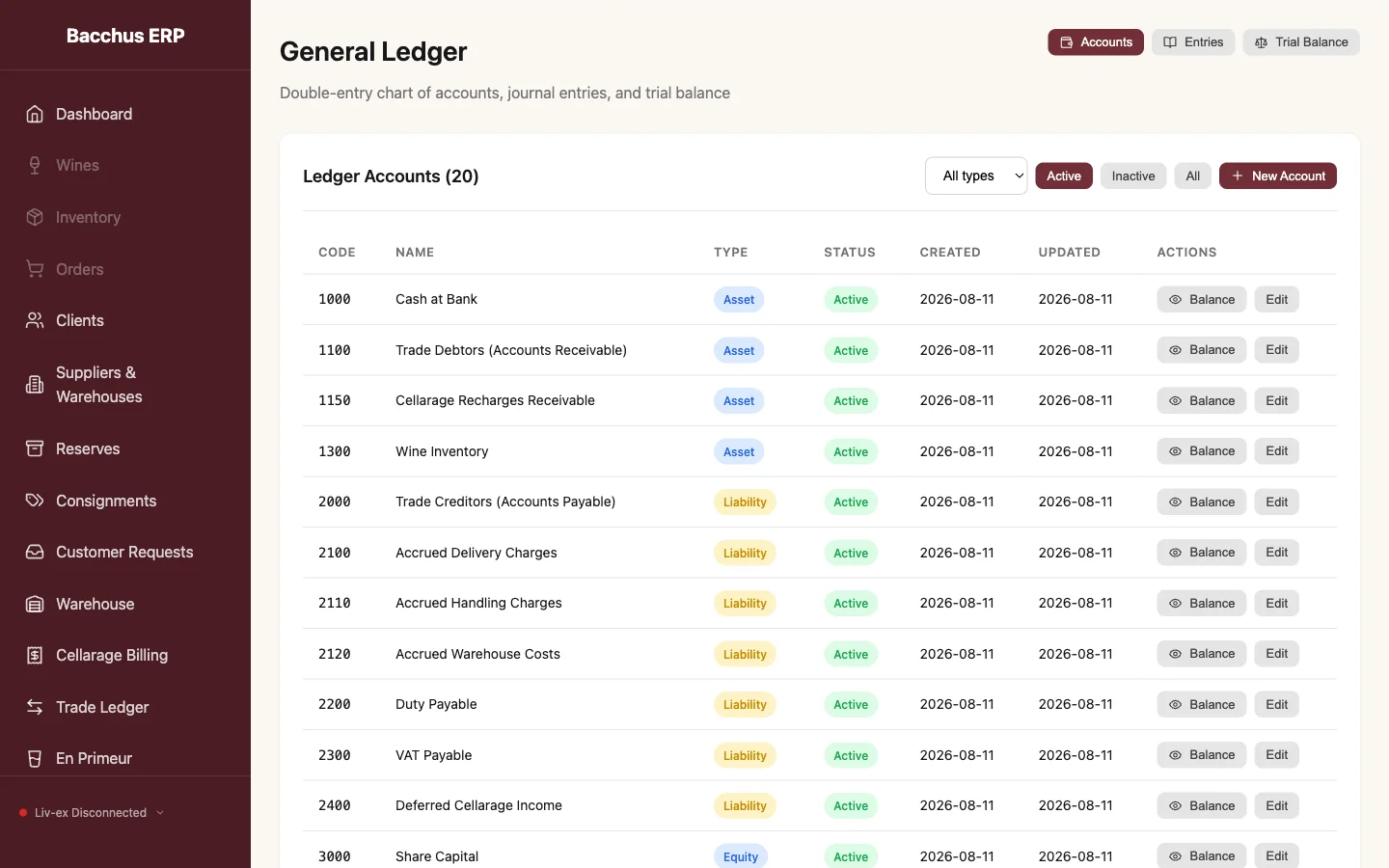
Built Around How the Fine Wine Trade Actually Moves
Bacchus ERP is built around that reality instead of working around it. Stock is modelled hierarchically — lot, case, bottle — so a split or a merge preserves full lineage instead of losing it. Bond status travels with the stock across warehouse locations, and duty and VAT are calculated automatically at the right point in the movement, effective-dated so historical rate changes recompute exactly, with the scheme applied per your jurisdiction’s rules — not a flat retail rate. En primeur allocations are a designed workflow — bound to ordered quantities, with automatic handling when a delivery comes in short — not a side spreadsheet someone reconciles by hand.
The result is a platform where the fine wine trade’s own mechanics are native: a case moving from an en primeur allocation, through bonded storage, to a client’s own holding is one continuous, auditable record — not several disconnected systems stitched together after the fact.
Lot-to-Case-to-Bottle Lineage
Every unit of stock in Bacchus ERP belongs to one of three levels — lot, case, or bottle — and carries its own identity: a pack format, a rotation number, a bond status, a location, and an owner. When a lot is broken down into cases, or a case into bottles, the children are recorded so their quantities sum exactly to the parent, and the record keeps the thread back to where each one came from. The reverse holds too: bottles can be repacked into a new case without losing that lineage.
This matters because fine wine genuinely moves this way — a six-case lot bought en primeur might leave your book as one case sold whole, one broken into individual bottles for a client’s own cellar, and the rest still sitting in bond — and a generic ERP’s fixed-SKU model simply has no place to hold that shape.
En Primeur Timing
En primeur wine is bought years before it exists as physical stock in your warehouse — allocated, invoiced, and tracked against a campaign long before a bottle is racked anywhere. Bacchus ERP treats that timing as a first-class part of the lifecycle rather than a side spreadsheet: allocation campaigns are bound to the quantity actually ordered, multi-supplier purchase orders are issued against them, and if a delivery comes in short, the reserve tied to the missing quantity flips to reflect that automatically rather than a person catching it during a stocktake later.
The gap between commitment and physical stock is exactly where wine-trade ERPs earn or lose trust — a case allocated in year one and landed in bond three years later still has to be the same recognisable record, not a fresh row that has to be reconciled by hand back to the original order. See our dedicated en primeur allocation software page for the full case for treating campaign timing this way.
Bond Status Transitions
A case of wine isn’t simply “in stock” — it’s en primeur, in bond, in transit, or duty paid, and which one it is changes the taxes owed, the paperwork required, and sometimes what you’re even allowed to do with it. Bacchus ERP tracks bond status as a property of the stock unit itself, across every bonded-warehouse location and operator you use, so a case moving from an en primeur allocation into a bonded site, and eventually out to a client duty paid, is one continuous record rather than several systems that have to be reconciled against each other by hand.
Stock can even be sold while it’s still in transit — recorded as a deferred claim with no money posted and no stock moved until the shipment actually lands, at which point the sale completes itself against the newly landed position.
Duty and VAT at the Point of Movement
Excise duty and VAT aren’t a flat retail rate applied once at checkout — they’re calculated at the specific point a movement triggers them, under whichever rate was actually in force on the day, and the calculation has to still be right years later when someone audits it. Bacchus ERP calculates both automatically, from the wine’s own ABV and volume, against effective-dated bands and schemes — so a movement from three years ago is still calculated at the rate that applied at the time, not today’s rate applied retroactively.
Duty Stays Suspended Until Withdrawal, Never Charged Twice
Duty stays suspended for as long as the wine sits in bond — nothing is charged on stock that hasn’t moved — and becomes due only at the point of withdrawal, when a fresh invoice is raised against that specific movement. Stock that already settled duty at an earlier withdrawal is never charged it a second time. VAT works the same way: your book is set to a standard or margin scheme, and the platform applies whichever one is actually in force, calculated against the correct value base for that scheme — see the worked duty & VAT preview for exactly how the figures are derived.
Provenance Continuity Across Ownership Change
The moment stock changes hands is where most systems lose the thread — a sale posts, a new record starts, and the case’s history before that point becomes a separate lookup nobody does under time pressure. Bacchus ERP keeps a single, read-only ownership-provenance timeline for every stock unit, tracing its lot/case/bottle lineage with each event labelled for how strongly it’s actually linked to the one before it — and an explicit list of what the data can’t confirm, rather than a confident-looking chain that’s quietly guessing in places.
That matters most at the one event genuinely worth getting right: moving stock from your own company holding to a client’s, atomically, in a single transaction, with the buyer’s holding landing on the position and unit ledger and the usual guardrails that stop a client being sold stock it already owns. This is a real, recently shipped capability — not something bolted on as an afterthought years after the rest of the platform — precisely because it’s the step the whole lineage model exists to protect.
How Does Bacchus ERP Track Bonded Stock Across Multiple Warehouses?
A merchant rarely stores bonded stock with a single operator forever. Stock moves between warehouses, or sits with more than one at once, and a system that only models bond status per warehouse forces someone to reconcile positions by hand across each one. Bacchus ERP tracks bond status as a property of the stock unit itself, not a property of any one warehouse's own system. So bonded stock held across multiple warehouse locations and operators is visible on one continuous record: what's en primeur, what's in bond, what's in transit, and what's already duty paid, regardless of which operator is physically holding it. Movement instructions to a bonded-warehouse operator are generated automatically the moment stock is released, with inbound confirmations reconciled against them and any mismatch flagged for review — across every operator, not just the one used most often.
What Makes Bacchus ERP a Wine ERP Built for Wine in Bond, Not Retail?
Most ERP platforms are built for stock that's either on the shelf or it isn't. That binary doesn't fit wine in bond, which can sit for years in a state where it's owned, tracked, and sellable, but not yet duty paid and not yet physically released. A wine ERP has to treat "in bond" as a first-class stock state with its own tax consequences, not a footnote bolted onto a generic inventory model built for a retail category. Bacchus ERP calculates UK excise duty and VAT automatically at the point wine actually leaves bond, using whichever rate and VAT scheme (standard or margin) applied on that specific day. Stock held in bond can be sold, transferred between warehouses, or partially withdrawn without ever losing track of which portion of a lot is still duty-suspended and which isn't. See the worked duty & VAT preview for exactly how a wine-in-bond withdrawal is calculated, or the full platform on our fine wine ERP software page.
Questions
Frequently Asked Questions
Why can't the fine wine trade just use a generic ERP?
A generic ERP treats a case of first-growth Bordeaux like a SKU of hardware. Bacchus ERP was designed from day one around how fine wine actually moves: by lot, by case and bottle, by allocation, by provenance. It was not bolted onto a system built for a different kind of stock.
How does Bacchus ERP handle en primeur allocations differently from a spreadsheet?
En primeur and other scarce releases don't sell like commodity stock. Bacchus ERP has allocation logic built in — bound to ordered quantities, with automatic handling when a delivery comes in short — so scarce releases go out tracked properly, not off a side spreadsheet.
What happens to a stock unit's provenance record when it changes hands?
Bacchus ERP keeps a single, read-only ownership-provenance timeline for every stock unit. It traces the unit's lot/case/bottle lineage, with each event labelled for how strongly it's actually linked to the one before it. The history does not restart when ownership moves from company stock to a client.
Does Bacchus ERP support both bonded and duty-paid stock in the same system?
Yes. Duty stays suspended for as long as the wine sits in bond. It becomes due only at the point of withdrawal, when a fresh invoice is raised against that specific movement. Duty and VAT are calculated automatically from effective-dated bands and schemes, so a movement from years ago is still calculated at the rate that applied at the time.
How does Bacchus ERP track bonded stock across multiple warehouses?
Bond status is a property of the stock unit itself, not of any one warehouse's own system. Bonded stock held across multiple warehouse locations and operators is therefore visible on one continuous record: what's en primeur, what's in bond, what's in transit, and what's already duty paid. That holds regardless of which operator is physically holding it.
What is wine in bond, and how does Bacchus ERP handle it?
Wine in bond is stock stored in an HMRC-approved bonded warehouse with duty and VAT suspended until it's withdrawn. Bacchus ERP tracks bond status as part of the stock unit's own record and calculates duty and VAT automatically at the point of withdrawal, using whichever rate and VAT scheme actually applied that day.